

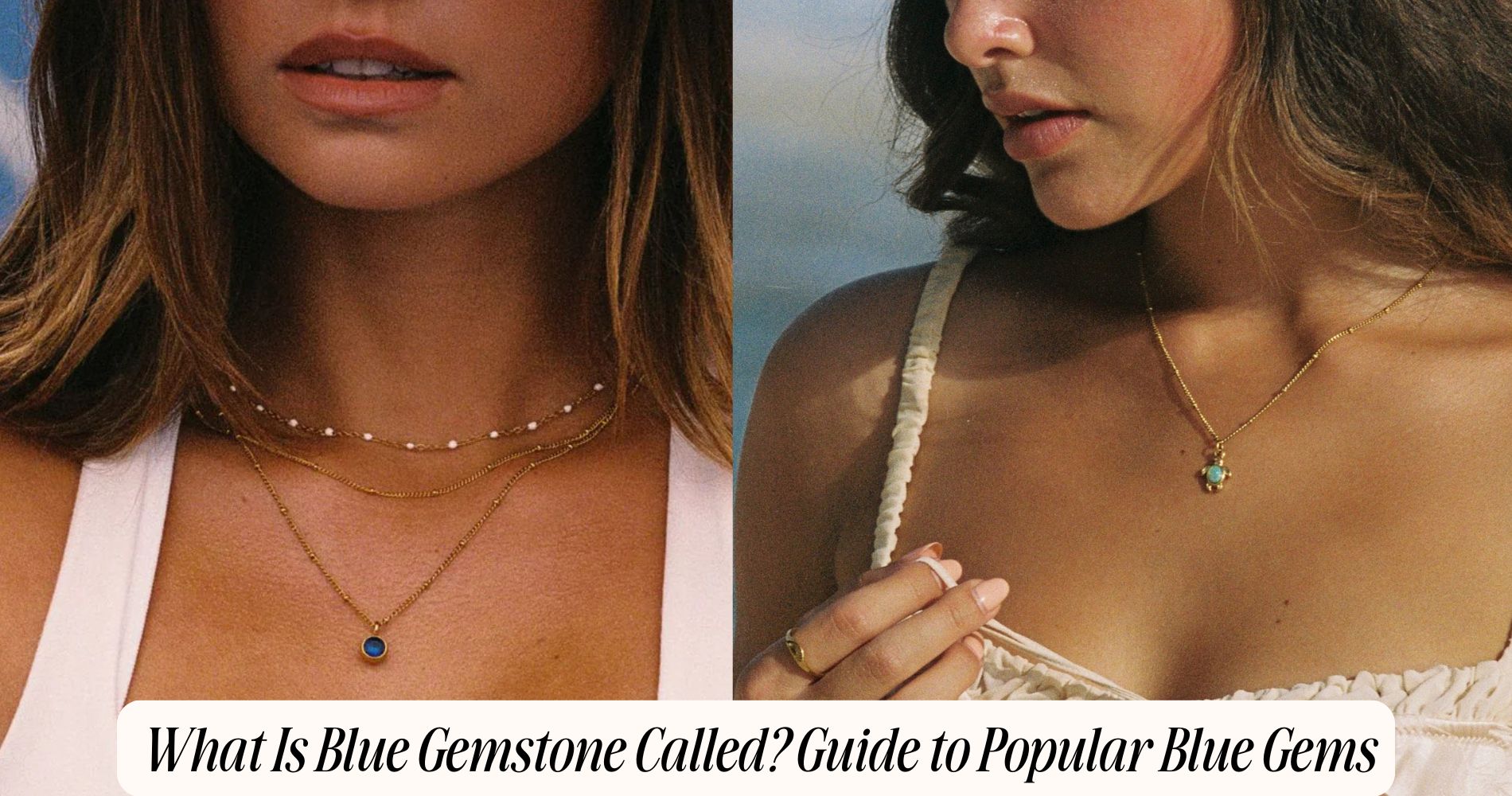
What Is Blue Gemstone Called? Guide to Popular Blue Gems
If you’ve ever wondered what is blue gemstone called, you might first think of sapphire. But “blue gemstone” actually refers to several minerals, each with distinct properties and price points. Classic royal-blue sapphire (corundum) is hardest after diamond, while aquamarine (beryl), blue topaz, and tanzanite offer lighter or violet-blue tones with varying durability and cost. Turquoise and lapis lazuli are opaque, historically prized blues. If you want to compare color behavior, hardness, and market value across these options, you’re in the right place — especially if you’re looking for pieces that pair perfectly with Atolea’s waterproof jewelry collection for daily, worry-free wear.
Sapphire: The Classic Deep Blue Gemstone
Sapphire anchors the blue gemstone category as a corundum variety (Al₂O₃) colored primarily by trace iron and titanium, producing hues from velvety royal blue to steely gray‑blue.
When you evaluate a sapphire, you’ll prioritize saturation and uniform color zoning, then clarity and cut.
You’ll also factor in sapphire durability: with a Mohs hardness of 9 and excellent toughness, it’s ideal for daily‑wear rings and heirloom settings.

Heat treatment to enhance color and transparency is standard and widely accepted in the trade, but you should expect price premiums for unheated stones with documented origin.
Sapphire symbolism centers on loyalty, wisdom, and protection, making it a preferred engagement stone and a stable store of value in the colored‑gem market.
Aquamarine: Soft Ocean Blues in Beryl Form
Although its color appears gentle, aquamarine is a robust blue‑green variety of beryl (Be₃Al₂Si₆O₁₈) colored primarily by Fe²⁺ (and sometimes Fe³⁺) substituting into the crystal lattice.
When you evaluate aquamarine properties, you’ll see hardness at 7.5–8 on the Mohs scale, excellent toughness, and typically high clarity with few inclusions, making it suitable for daily‑wear jewelry.
You’ll find crystals commonly forming hexagonal prisms, often large, which allows cutters to fashion sizeable stones with minimal waste.
Heat treatment can drive Fe³⁺ to Fe²⁺ states, refining color toward purer blue.
In aquamarine symbolism, the gem conveys clarity, calm, and maritime protection, which supports steady demand.
Fine Santa Maria–type material commands premiums, especially in unheated, saturated hues.
Blue Topaz: Bright, Affordable Sparkling Blues
Blue topaz delivers vivid, high‑brilliance blues at a price point far below most comparable gems, thanks largely to routine treatment of colorless or pale topaz (Al₂SiO₄(F,OH)₂) with irradiation and controlled heat.
When you evaluate blue topaz properties, you’re looking at a hard 8 on the Mohs scale, high clarity, strong vitreous luster, and refractive indices around 1.61–1.64, all of which support sharp, bright faceting.
You’ll also want to understand blue topaz history. Natural blue material is rare; most commercial “Swiss,” “London,” or “Sky” blue stones start as near‑colorless topaz, then gain stable color through modern treatment protocols.
This reliable, large‑scale production keeps calibrated sizes abundant and prices accessible for jewelry across many markets.
Tanzanite: Vivid Violet-Blue From Tanzania
Where blue topaz optimizes treated brilliance and affordability, tanzanite offers a rarer, more complex violet‑blue rooted in distinctive crystal chemistry.
You’re dealing with a vanadium‑bearing zoisite, mined almost exclusively from a narrow corridor near Merelani Hills, making Tanzanite origins extraordinarily restricted and geologically unique.
You see pronounced pleochroism: the crystal can show blue, violet, and burgundy depending on cut and orientation.
Heat treatment stabilizes the desirable violet‑blue, but doesn’t erase the directional color zoning you’ll notice in well‑lit examination.
Tanzanite value hinges on saturation, medium‑dark tone, and minimal brown or gray modifiers.
Fine stones display a pure, electric violet‑blue and eye‑clean clarity.
Because the deposit is finite and production inconsistent, you should expect ongoing price volatility and strong interest in top grades.
Turquoise: Opaque Sky Blue With Ancient Appeal
Even as fashions shift, turquoise holds a stable niche as an opaque copper‑aluminum phosphate that delivers sky‑to‑greenish blue color rather than transparent brilliance.
You’ll see it as vein-filled nodules in arid, copper-rich regions, often stabilized to improve porosity and durability. Fine material shows tight texture, minimal matrix, and evenly saturated “robin’s-egg” blue.
When you study turquoise history, you track trade routes from ancient Egypt and Persia through the Silk Road to the American Southwest.
Those long traditions still guide today’s value language: “Persian-type” for clean, vivid blue, “sleeping beauty” for smooth, matrix-free material.
Turquoise symbolism—protection, success, and sacred connection—helps sustain demand, especially in Native American and boho-luxury jewelry, though you must navigate imitations and dyed howlite.
Lapis Lazuli: Royal Blue Stone With Golden Flecks
Lapis lazuli anchors the concept of “royal blue” as a rock, not a single mineral: a dense aggregate dominated by lazurite, with variable calcite, pyrite, and minor silicates.
You’ll recognize quality by its saturated ultramarine bodycolor, minimal whitish calcite veining, and fine, evenly dispersed pyrite that creates those prized golden flecks.
When you trace lapis lazuli history, you’re looking at one of humanity’s earliest gem materials, mined for millennia in Afghanistan’s Badakhshan deposits and ground into ultramarine pigment for Renaissance art.
Lapis lazuli symbolism centers on royalty, intellect, and spiritual insight, making it popular for statement cabochons, inlay, and carvings.
In today’s market, you must distinguish natural, dyed, and reconstituted material to price and purchase confidently.
Blue Diamond: Rare and Highly Prized Blue Brilliance
While lapis lazuli built the visual vocabulary for royal blue in opaque form, blue diamonds embody that color in the rarest, most refractive medium nature offers. Their hue usually comes from boron impurities substituting for carbon in the crystal lattice, creating selective absorption that yields steel, ice, or deep ocean blues.
You’ll see blue diamond rarity reflected in grading reports: even faint blue commands a premium, while “Fancy Vivid Blue” sits at the market’s apex. Clarity matters, but saturation and tone dominate pricing models and auction results.
To evaluate blue diamond value, you’ll weigh origin (natural vs. treated or lab‑grown), modifier colors (gray, green), and size.
Natural, untreated stones above 1 carat with pure, intense blue remain exceptionally scarce.
Other Blue Gems: Spinel, Zircon, Kyanite, and More
Beyond the marquee names, a broad suite of blue gemstones—most importantly spinel, zircon, and kyanite—offers distinct chemistries, optical behavior, and value profiles that are worth parsing.
Blue spinel, a magnesium aluminum oxide, shows a cubic lattice, no pleochroism, and strong dispersion; cobalt-bearing spinel varieties can rival fine sapphire yet remain undervalued, especially in smaller calibrated sizes.
Blue zircon, a zirconium silicate, displays very high refractive index and birefringence; when you assess zircon clarity, even minor inclusions can diffuse its characteristic “diamond‑like” brilliance.

Heat treatment’s common and usually stable.
Kyanite, an aluminum silicate with pronounced anisotropy, exhibits strong pleochroism and perfect cleavage, making cutting and setting more challenging and limiting price growth, despite its saturated, often sapphire‑like hues.
How to Choose the Right Blue Gemstone for You
When you choose a blue gemstone, you’re really balancing three variables: performance (optical and durability), chemistry/structure, and market dynamics.
Start by defining use: for daily-wear rings, you’ll favor higher Mohs hardness and toughness (sapphire, spinel); for occasional wear, you can accept softer species (apatite, fluorite).
Next, evaluate optics. Consider refractive index, pleochroism, and dispersion to decide if you want a saturated, velvety blue or a bright, high-sparkle look.
Link this to color symbolism—royal, tranquil, or electric blues signal very different moods.
Then, study chemistry and treatments: beryllium diffusion, irradiation, or fracture filling affect value and stability.
Finally, align budget with rarity and origin, while preserving a personal connection to the stone’s hue and history.
Frequently Asked Questions
Which Blue Gemstones Are Most Suitable for Engagement Rings and Daily Wear?
You’ll find sapphires best for engagement rings thanks to sapphire durability, hardness, and stability; aquamarine and blue topaz also perform well. Avoid turquoise versatility for daily-wear rings; its porosity, lower hardness, and treatment sensitivity reduce long-term structural reliability.
How Do I Tell if a Blue Gemstone Has Been Heat- or Dye-Treated?
You inspect color observation under magnification: look for uneven saturation, dye concentrations in fissures, or surface-reaching fractures. For treatment identification, request spectroscopy, refractive index, and lab reports; sellers should disclose heat or dye enhancements explicitly.
Are There Ethical or Conflict-Free Options for Sourcing Blue Gemstones?
You can source ethical, conflict‑free blue gemstones by prioritizing traceable supply chains, third‑party certifications, and miners using ethical sourcing and sustainable practices, including reduced chemical inputs, fair‑wage artisanal operations, and verifiable origin data from reputable dealers or mine‑to‑market programs.
What Blue Gemstones Are Safest for Ultrasonic or Steam Cleaning?
You’ll get safest cleaning in ultrasonic or steam with untreated blue sapphire, spinel, chrysoberyl, and most aquamarine; verify ultrasonic safety by confirming no fracture-filling, heavy inclusions, or instability from heat-sensitive treatments like resin, glass, or dye.
How Do Astrological or Healing Beliefs Differ Between Various Blue Gemstones?
You’ll find sapphire linked to discipline and protection, aquamarine to communication, and lapis to intuition; each stone’s astrological meanings and healing properties vary, influencing consumer demand, price premiums, and how practitioners select stones for targeted energetic applications.
Conclusion
When you evaluate blue gemstones, think regarding crystal system, durability, and market dynamics. Sapphire and diamond lead for hardness and long-term value; aquamarine, topaz, and tanzanite offer strong color–price ratios but need mindful wear. Opaque turquoise and lapis lazuli deliver historic appeal and distinctive textures. Always confirm treatments, origin, and certification, then align hue, saturation, and clarity with your budget so you’re buying both aesthetic impact and sound mineralogical investment.





Leave a comment
This site is protected by hCaptcha and the hCaptcha Privacy Policy and Terms of Service apply.